English and French to Remain Core to Ghana’s Education System Amid Mother Tongue Policy Clarification
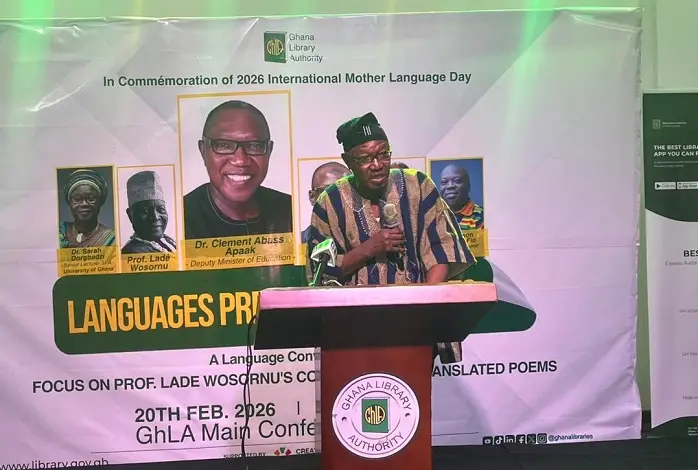
Ghana’s Deputy Minister for Education, Clement Apaak, has clarified that English and French will remain integral to the country’s education system, amid public debate over the government’s renewed emphasis on mother tongue-based instruction in early childhood education.
Speaking at a national language convention organised by the Ghana Library Authority to mark International Mother Tongue Day in Accra, the Deputy Minister outlined the structure of the existing policy and rejected claims that the government intended to sideline foreign languages.
According to Dr Apaak, Ghanaian languages will be used for approximately 70 percent of instruction from kindergarten through Primary Three, in line with long-standing pedagogical policy. English and French will continue to be taught as subjects at that level.
From Primary Four onward, English becomes the principal language of instruction.
His remarks also sought to clarify comments attributed to Education Minister Haruna Iddrisu, amid suggestions that the ministry intended to abandon English or French in early education.
The clarification signals continuity rather than policy reversal, reinforcing bilingual, and in some cases multilingual, foundations within Ghana’s formal education framework.
The Ministry’s position is grounded in research supporting mother tongue-based instruction in foundational learning stages. According to the Deputy Minister, children grasp concepts more effectively when taught in a familiar language during early cognitive development.
The policy aims to:
Improve literacy and numeracy acquisition
Reduce early-grade learning poverty
Enhance classroom participation and creativity
Promote equitable access to quality education
The broader logic reflects global evidence that early immersion in unfamiliar languages may hinder comprehension and foundational skill development, particularly in multilingual societies.
To operationalise the policy, the Ministry of Education is collaborating with the Bureau of Ghana Languages and tertiary institutions to translate core materials, especially mathematics and science texts, into selected Ghanaian languages.
The Ghana Education Service is also supporting cultural integration initiatives, including inter-school competitions featuring Ghanaian language renditions of the National Anthem and National Pledge.
An implementation committee chaired by Professor George K.T. Oduro has been established to oversee reforms emerging from the President’s National Forum on Education, suggesting institutional coordination beyond rhetorical commitment.
The Executive Director of the Ghana Library Authority, Alhassan Ziblim, framed language preservation as central to national identity and cultural continuity. He warned that several indigenous languages face extinction without deliberate policy intervention.
Planned measures include expanding indigenous-language collections in libraries, supporting translation projects, and hosting community reading festivals and storytelling events.
International partners also endorsed the direction. The Ghana Country Representative of UNESCO, Edmond Moukala, called for preserving Ghanaian languages in both print and digital formats. Meanwhile, the Secretary-General of the Ghana National Commission for UNESCO emphasised that multilingual education aligns with global commitments under the Sustainable Development Goals.
The renewed emphasis on indigenous languages reflects a broader recalibration in education policy: balancing global competitiveness with cultural preservation.
English remains Ghana’s official language and the primary medium for higher education, governance, and international engagement. French, given regional integration dynamics within West Africa, retains strategic relevance.
The policy therefore represents not a shift away from global languages, but an attempt to strengthen foundational literacy while safeguarding linguistic heritage.
The success of the initiative will depend on teacher preparedness, availability of high-quality translated materials, and consistent monitoring of learning outcomes. Without sufficient training and resourcing, implementation gaps could undermine intended gains.
For now, the government’s position to multilingual education will remain central to Ghana’s development strategy, with indigenous languages strengthened in early years, and English and French preserved as pillars of national and international engagement.
0 Comments
No comments yet. Be the first one to comment!